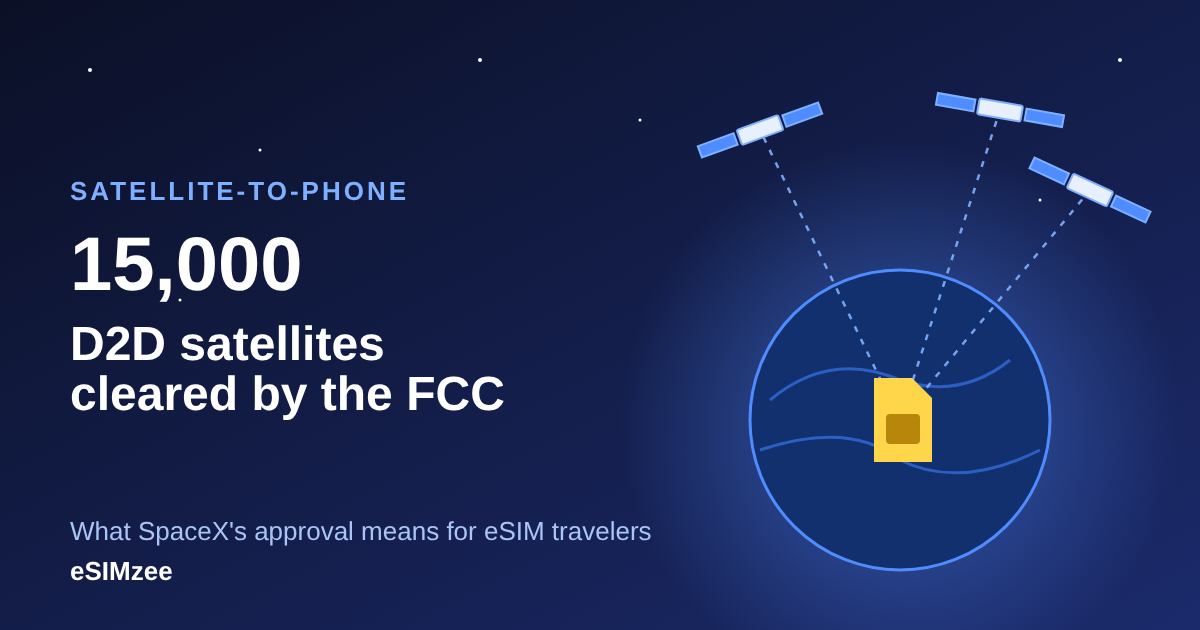
The FCC (Federal Communications Commission) cleared SpaceX on October 7 to deploy 15,000 direct-to-device (D2D) satellites, and a day later SpaceX agreed to buy Grain Management's 800MHz spectrum. Together the moves push Starlink Mobile toward a full mobile service. Travelers who rely on eSIMs (embedded SIMs) should watch what comes next.
The FCC approval
The order lets SpaceX operate the satellites in nine orbital shells and use specified spectrum, including spectrum it recently acquired from EchoStar, according to Light Reading. The authorization runs 15 years from the day the first new D2D satellite reaches its authorized orbit.
The deadlines are firm. SpaceX must launch 50% of the maximum number of satellites by October 7, 2032, and finish the constellation by October 7, 2035.
The order also paves the way for higher-capacity "V2" satellites. SpaceX targets user speeds up to 150 Mbit/s for V2, up from 4 Mbit/s on the current offering, which runs on more than 650 D2D satellites.
The Grain spectrum deal
On October 8, Grain said SpaceX would acquire 100 percent of its nationwide 800MHz portfolio, subject to FCC approval and other closing conditions, per RCR Wireless News. The deal gives SpaceX up to 14MHz of paired spectrum. The companies did not disclose financial terms, and the Wall Street Journal valued the transaction at around $8 billion.
Low-band spectrum travels far and penetrates walls. Light Reading reports that SpaceX calls this spectrum one of the key remaining technical gaps on its path to becoming a major mobile carrier in the US. SpaceX says Starlink Mobile will combine its satellite constellation with a terrestrial deployment once the FCC gives final approval.
Analysts split on what it delivers
Evercore ISI analyst Kutgun Maral called the 14MHz "relatively modest" and described the deal as "more of a coverage fix than a capacity solution," per Light Reading. He also called it the clearest signal yet that Starlink Mobile is moving toward a credible direct-to-consumer US service.
MoffettNathanson analyst Craig Moffett holds that SpaceX still needs an MVNO (mobile virtual network operator) agreement with AT&T, Verizon or T-Mobile to compete. Those three carriers have said they do not intend to sign one.
RCR Wireless News cites analyst Vish Nandlall, who argues that spectrum gives coverage rather than much capacity. He cites Bernstein Research estimates that a competitive nationwide network will cost between $50 billion and $130 billion to build.
The carrier response
AT&T, T-Mobile and Verizon launched a D2D joint venture last week, run by interim CEO Paul Roth, according to Light Reading. The venture pools spectrum and offers a technology-neutral platform for satellite coverage beyond terrestrial reach.
Demand today is small. T-Mobile CEO Srini Gopalan noted that D2D usage represents just 0.0002% of the operator's total network usage. Light Reading adds that T-Mobile removed references to Starlink from its T-Satellite website, and Canada's Rogers did the same on its Rogers Satellite site.
What this means for travelers
This story covers US spectrum and US approvals. It does not change how a travel eSIM works abroad today, and none of the sources describe roaming or international eSIM plans for Starlink Mobile.
The direction matters, though. SpaceX targets coverage where terrestrial networks do not reach, and the FCC order cites services for consumers in the US and worldwide. Satellite coverage and eSIM data plans are converging, and carriers are fighting over who controls that layer.
For now, pick a plan on the networks that carry your data today. Compare coverage, data allowances and prices across eSIM providers on eSIMzee, and check back as satellite offers move from the US to other markets.
Sources
- FCC OKs SpaceX to deploy 15K D2D satellites, and nine years to complete it, Light Reading, October 7, 2026
- SpaceX: Grain's lowband spectrum is our ticket to becoming 'major mobile carrier', Light Reading, October 9, 2026
- SpaceX grabs "earthquake" 800 MHz deal as Starlink rocks US telcos, RCR Wireless News, October 9, 2026