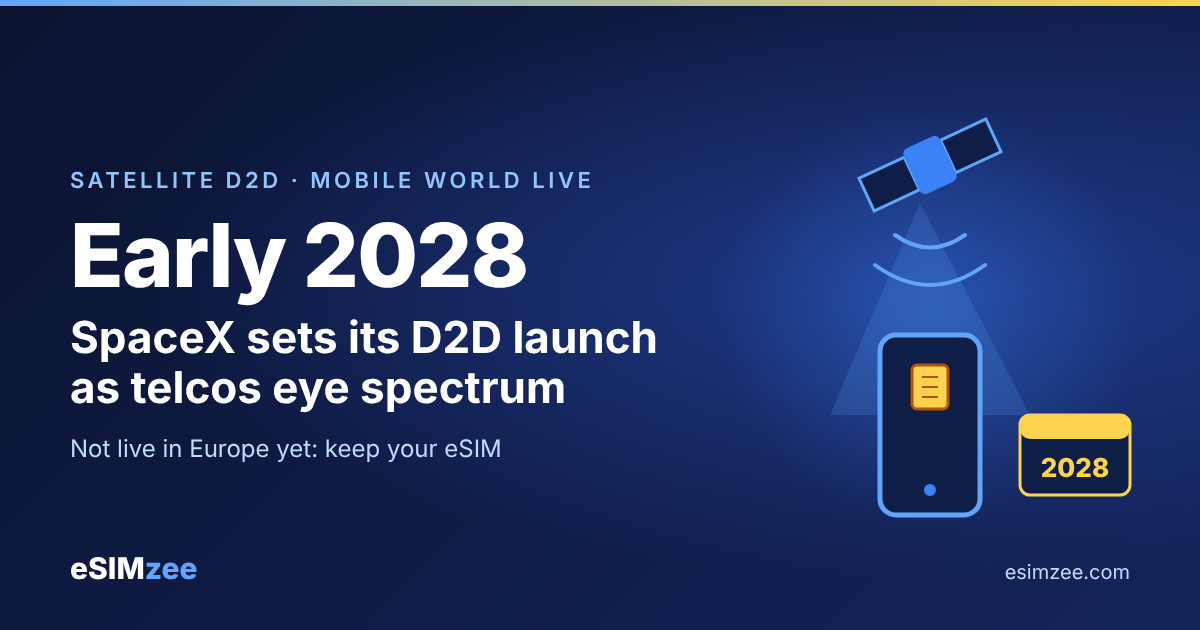
SpaceX plans to launch its own D2D satellite service in early 2028, while four of Europe's biggest operators prepare a joint bid for satellite spectrum. Direct-to-device (D2D) means a normal phone connects to a satellite without extra hardware. For travelers, the race decides where phones get coverage beyond the cell towers, but none of it replaces a data plan today.
SpaceX sets an early 2028 date for its D2D satellite service
SpaceX president Gwynne Shotwell told investors the company plans to activate its D2D service in early 2028, after it deploys second-generation Starlink Mobile satellites in 2027. Mobile World Live reported that she said the spectrum purchase and the FCC approval for 15,000 next-generation V2 satellites "pave the way" for Starlink Mobile to become a major US carrier.
The spectrum keeps growing. Light Reading reports that the FCC approved SpaceX's purchase of three AWS-3 licenses from Tristar License Group on October 21. The licenses cover 62 counties in eight US states and add to the near-nationwide AWS-3 holdings SpaceX built from EchoStar and an FCC auction.
SpaceX also agreed to buy up to 14 MHz of paired 800 MHz spectrum from Grain Management, according to Mobile World Live. The low-band airwaves are meant to help signals penetrate buildings. Shotwell said the company will also use ground-based femtocells (small radio units) at Starlink installations.
AT&T pushes back on the satellite threat
AT&T CEO John Stankey answered the plan on his company's own earnings call. Mobile World Live reports he said AT&T operates six to eight carriers of low-band spectrum, against one for SpaceX, and that "we've got the scale where the scale matters."
Shotwell, in turn, estimated that Wi-Fi carries between 85% and 93% of mobile connectivity and said SpaceX can pair its spectrum with Wi-Fi indoors. The two executives disagree on how fast satellite networks can match the performance customers expect.
Europe's operators plan a joint satellite spectrum bid
Deutsche Telekom, Orange, Telefonica and Vodafone Group signed a letter of intent to explore a joint bid for spectrum reserved for Mobile Satellite Services (MSS), Mobile World Live reports. They plan to build ground infrastructure and monitoring functions without investing in a constellation. They have not yet chosen a satellite partner.
Timing is tight. Counterpoint Research senior analyst Subhadip Roy noted that the existing 2 GHz authorizations held by Viasat and EchoStar expire in May 2027, and the European Commission is drafting a new allocation framework.
Why D2D satellite service is slow to arrive in Europe
Light Reading reports that Orange postponed its Romania satellite test to early next year because too few satellites are in orbit. AST SpaceMobile moved its launch plans from the end of 2026 to early 2027, and its limited coverage by year-end will not include any EU country.
Orange already offers a very limited satellite messaging service through Skylo. It works only on Google Pixel 9 and Pixel 10 phones. Orange's technology chief said large scale needs support for many more handsets.
What this means for travelers
No D2D service from these announcements works for a European holiday today. Plan your trip data the way you do now: a travel eSIM keeps you online at local network rates wherever you land. Compare current prices on eSIMzee's provider pages.
Satellite coverage will first fill gaps outside cell range, not replace a data plan. Watch for the 2027 spectrum decisions in Europe and the 2028 SpaceX launch. They will show whether satellite becomes a standard feature of mobile plans or a paid extra.
Sources
- The Friday File: Microsoft; European satellite; SpaceX, Mobile World Live, October 23, 2026
- AT&T CEO Stankey argues scale matters in satellite debate, Mobile World Live, October 21, 2026
- SpaceX clinches deal to use Tristar's spectrum for D2D, Light Reading, October 23, 2026
- Orange to test D2D service next year as it waits for satellite coverage, Light Reading, October 22, 2026