Deutsche Telekom is expanding agentic AI in telecom from one live radio network agent to a platform that runs whole-network operations. RCR Wireless News reports the details from the operator's recent AI Investor Day. For anyone who travels to concerts, matches or festivals, the first system already targets the crowd congestion that slows your data.
What is RAN Guardian?
RAN Guardian is a multi-agent system for the radio access network (RAN), the part of the mobile network that connects phones to cell towers. It uses three agents. A scanning agent collects event information from public media, social media and other sources. A monitoring agent assesses the technical impact, and a remediation agent acts before the event.
The remediation agent changes settings such as carrier aggregation, uplink and antenna tilt to move capacity to where crowds gather. Armin Sumesgutner, Deutsche Telekom's chief network officer, said planning is static and the network is "always behind the wave," according to RCR Wireless News.
Deutsche Telekom first presented the agent with Google Cloud in February 2025. Deutsche Telekom's announcement says it is built on Gemini 2.0 in Google Cloud's Vertex AI and can recommend or autonomously apply corrective actions.
How much does agentic AI in telecom change event coverage?
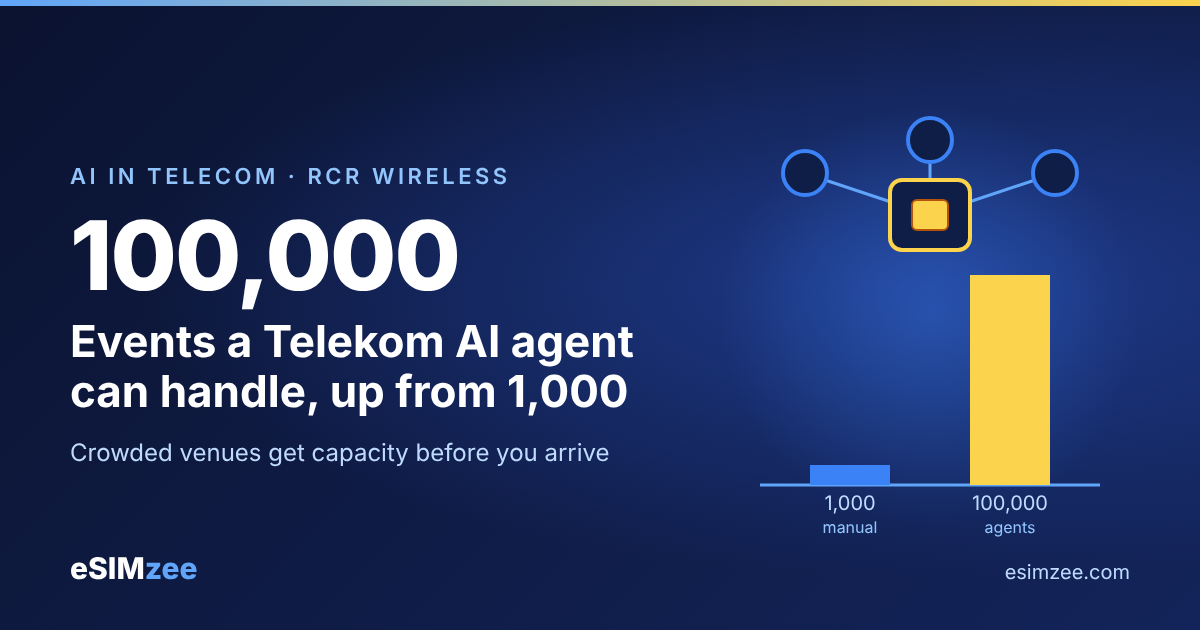
The numbers come from Sumesgutner's presentation as reported by RCR Wireless News. Manual work previously covered roughly 1,000 events. The agentic approach can analyze and remediate 100,000 events.
RAN Guardian went live in Germany in November 2025 and triggered more than 100 autonomous remediation actions in its first month, the same report states. Deutsche Telekom says the system aims to avoid 24 million minutes of poor customer experience.
Many congestion cases resolve fully automatically. Others still need a human to confirm the fix.
What is MINDR, the next step?
MINDR is a modular autonomous observability and incident management platform. Arash Ashouriha, Deutsche Telekom's group technology officer, describes four steps: correlate signals across the network, diagnose root causes with specialized agents, execute and verify fixes within set guardrails, then learn from each outcome.
Low-impact issues can be fixed autonomously. Every critical change goes to a human for approval before it runs.
Deutsche Telekom targets more than 90% automated ticket handling, issue qualification in under 15 minutes and resolution in under one hour. It also targets a 30% productivity gain and a move to Level 4 autonomous networks. An initial MINDR use case is planned as a minimum viable product in Germany by the end of 2026.
Is the industry ready to remove humans from the loop?
Not yet. Fierce Network reports that Ericsson and Telstra are extending their autonomous networks work to the question of how operators can safely hand network decisions to AI without keeping a human in the loop.
Another Fierce Network piece reports Ericsson's Mats Karlsson arguing that true autonomy requires intent-based operations, modern operations and business support systems (OSS/BSS) and a business case beyond chasing autonomy levels. Fierce Network summaries are the basis for both items; the full articles were not readable.
What this means for travelers
Network agents work on the operator side, so nothing changes in how you install or buy an eSIM. The benefit shows up where it hurts most: crowded venues, where Deutsche Telekom's agents now prepare capacity ahead of time.
Your choice still starts with the plan. Compare data, validity and price across providers on the eSIMzee provider pages before you fly.
Sources
- Deutsche Telekom expands agentic AI from RAN to network-wide automation, RCR Wireless News, 21 October 2026
- Deutsche Telekom and Google Cloud Partner on Agentic AI for Autonomous Networks, Deutsche Telekom, 25 February 2025
- Ericsson, Telstra push autonomous networks beyond automation with 'knowledge' layer, Fierce Network, 21 October 2026 (RSS summary)
- Ericsson's Karlsson: Don't confuse AI automation with network autonomy, Fierce Network, 20 October 2026 (RSS summary)