The GSMA, the global mobile industry association, has published its position on the NANDA Index, a proposed directory that would let AI agents find and verify each other. The GSMA article, dated 23 October 2026, argues that operator identity checks and standardised APIs could complement it. For travelers who may one day let an AI assistant handle their connectivity, the NANDA Index and AI agents' identity checks decide who gets to act for you.
What is the NANDA Index?
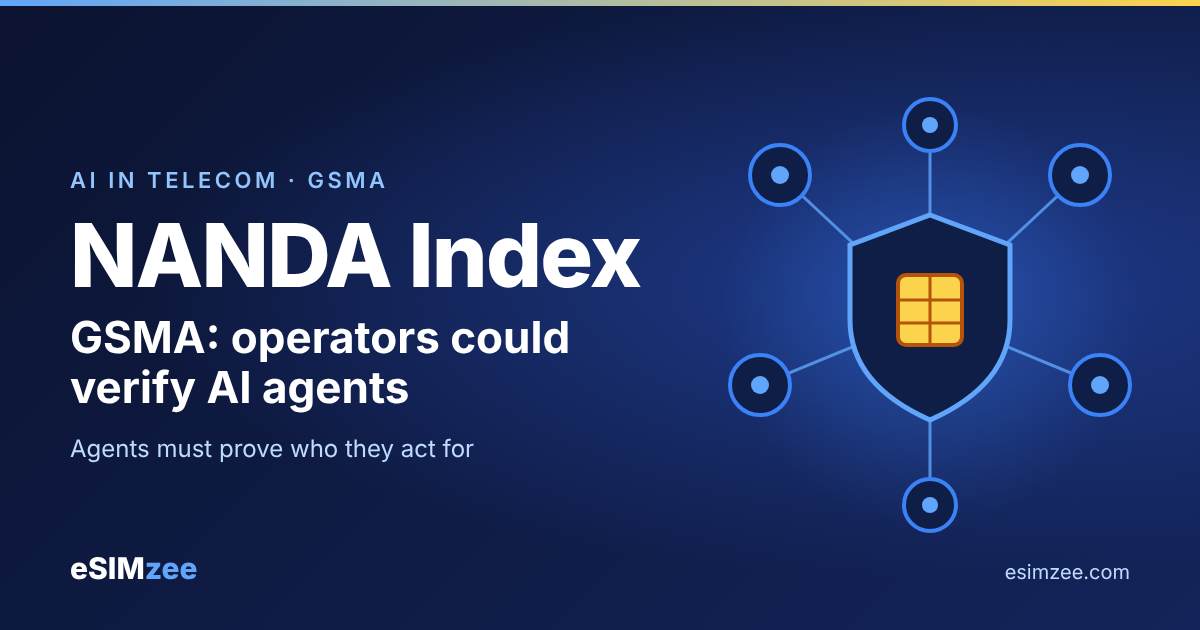
The NANDA Index comes from Professor Ramesh Raskar and the MIT Media Lab. It explores open infrastructure for an internet of AI agents, according to GSMA.
The authors' arXiv paper, submitted on 18 July 2025, describes a "minimal lean index" that points to cryptographically verifiable records called AgentFacts. They argue that DNS, the system that turns website names into addresses, will not scale to the billions or trillions of autonomous agents they expect.
The paper lists sub-second revocation and key rotation among its design goals. In plain terms, a compromised agent could lose its credentials almost instantly.
How does GSMA want operators involved?
GSMA calls NANDA a "promising approach" to agent discovery. The index does not force one central registry. It links independently run discovery systems through a common resolution layer.
GSMA says this federated design suits telecom operators, which already run federated infrastructure across markets, regulators and service providers. It names three operator strengths: network-based identity verification, standardised APIs and secure connectivity.
The article links these to GSMA Open Gateway and CAMARA, two programs that expose network capabilities to developers through standardised APIs. It also cites Open Telco AI, a group of operators, technology companies, developers and academics building telecom-grade AI.
Why does AI agent trust matter?
GSMA sets a clear bar. Agents should be able to prove who they are, what they are authorised to do and on whose behalf they act. Consumers should keep clear permissions, privacy safeguards, traceability and protection against abuse.
The article also reports that AT&T post-trained the OTel family of open telecom models with GSMA and collaborators. It counts more than 30 models, trained to abstain when reliable information is unavailable.
The GSMA article does not mention SIM or eSIM, and it gives no timeline, funding or membership terms for NANDA. Treat this as a direction, not a launch.
How are operators using agentic AI today?
Operators are applying agents inside their own networks first. A Light Reading report from 28 October 2026 covers a FutureNet webinar with executives from Orange, Telenor, Vodafone and Polystar.
Polystar's Thomas Nilsson said agents can find the root cause of an issue in minutes rather than the hours a person may need. Vodafone's Mabel Pous Fenollar described agents coordinating teams after a fiber break. Orange's Alexis Koalla said humans stay responsible for sensitive network changes.
Koalla also named the open problem: "The key challenge is how to translate these technical KPIs into business outcomes." Light Reading adds that data quality, skills and governance still limit how far operators can scale.
What this means for travelers
Nothing changes at checkout today. You still pick a plan, scan a QR code and install your eSIM yourself. Compare plans by price, data and validity on the eSIMzee provider directory.
The direction matters, though. If AI assistants start booking connectivity for you, GSMA's test is the right one: the agent must prove it acts for you and has permission to spend. Until that exists, keep purchases in your own hands.
Sources
- NANDA Index: Connecting the Mobile World to the Open Agentic Web, GSMA, 23 October 2026
- Beyond DNS: Unlocking the Internet of AI Agents via the NANDA Index and Verified AgentFacts, Raskar et al., arXiv, 18 July 2025
- Telcos want more than efficiency from agentic AI, Light Reading, 28 October 2026