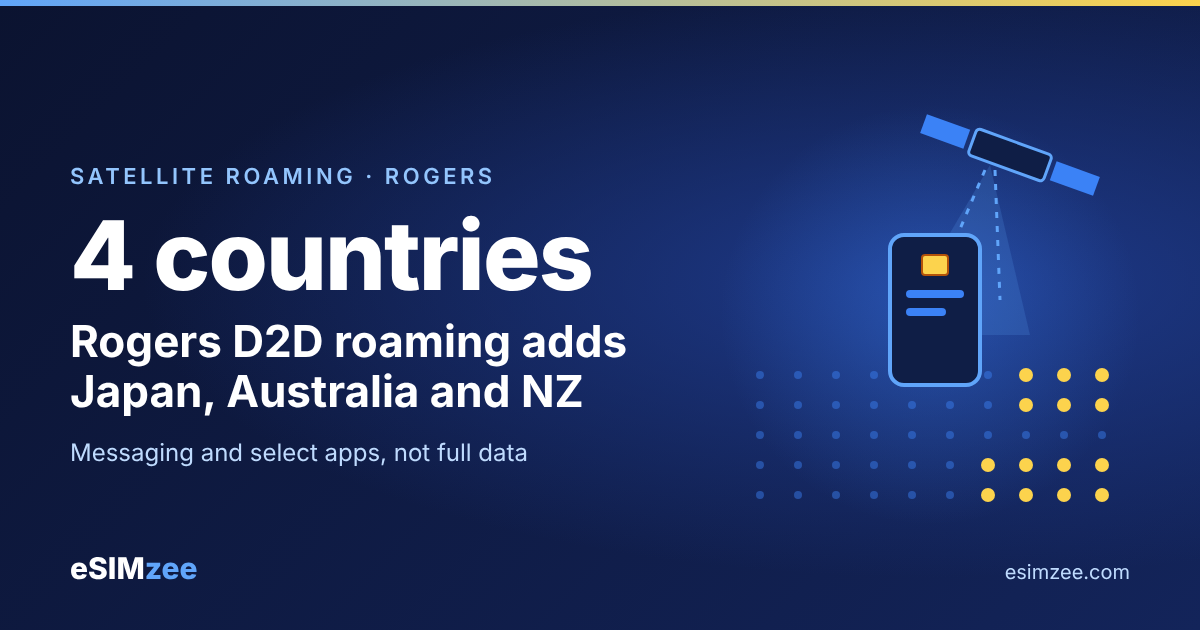
Satellite roaming just crossed the Pacific. Canadian operator Rogers now lets its customers use its direct-to-device (D2D) satellite service in Japan, Australia and New Zealand, according to Mobile World Live.
What Rogers announced
Rogers struck roaming deals covering key nations in and around the Pacific Ocean. The launch brings the number of non-domestic countries with access to four, per Mobile World Live. The United States was added earlier this year through a roaming deal with T-Mobile US.
Rogers chief technology officer Mark Kennedy said Canadians want to stay connected wherever their travels take them, as MobileSyrup reports. MobileSyrup adds that the service runs on Starlink.
What satellite roaming gives you
The service is built for messaging and a short list of apps. Rogers customers can reach WhatsApp, Facebook Messenger and X, plus Google mapping, AllTrails and AccuWeather weather updates, per Mobile World Live.
The sources describe messaging and selected apps, not a full data plan, so treat it as a backup.
Who gets it, and how
Access depends on the plan you hold at home. Satellite roaming is included in Rogers Ultimate plans, in eligible Roam Like Home options and in select Travel Passes, according to MobileSyrup. Those passes are the International and International + Cruises options.
Rogers' own Japan roaming page lists satellite-to-mobile roaming in Japan as a new feature of its Asia and International Travel Passes. The same page says a Travel Pass uses the data, talk and text already in your mobile plan and has no separate data bucket.
Mobile World Live says the Japan arrangement looks likely to run through KDDI, which asked Rogers earlier this year to provide roaming access for KDDI's own D2D users. Rogers has not confirmed that detail in the sources we read.
Why the satellite roaming race is accelerating
Operators now sell D2D as continuity, not capacity. At RCR Wireless News' NTN Integration Forum, Orange said demand for always-on satellite messaging held up even where terrestrial coverage is near complete, and that resilience after this summer's forest fires outranked the original business case, as RCR Wireless News reports.
The same report says Kyivstar's Starlink layer reached more than 10% of its customer base within a month and 7.5 million unique users in nine months. Orange's service with Skylo works on Google Pixel 9 and later in France, and the customer stays an Orange customer.
Regulators are clearing the road. The US Federal Communications Commission (FCC) proposed auctioning 25MHz of spectrum for D2D and terrestrial services, and separately sought comment on opening nearly 482MHz across eight more bands for satellite-to-phone coverage, per Mobile World Live. The commissioners backed both proposals unanimously.
What this means for travelers
Satellite roaming is a safety net, not a data plan. Check whether your home operator has a D2D roaming deal for your destination before you rely on it, because coverage depends on the agreement between operators.
For everyday data abroad, you still need a regular connection. A travel eSIM gives you local-rate data on arrival without swapping your SIM. Compare plans by country and provider on the eSIMzee providers page, and keep your home line active for messages and bank codes.
If you hike, sail or travel through remote regions of Japan, Australia or New Zealand, ask your home operator about satellite messaging. If you stay in cities, a travel eSIM covers your needs.
Sources
- Rogers expands D2D roaming reach, Mobile World Live, 30 October 2026 (RSS text)
- Rogers expands satellite-to-mobile coverage internationally, MobileSyrup, 29 October 2026
- Japan roaming and Asia Travel Pass, Rogers, accessed 2 November 2026
- Direct-to-device leaves the lab as Orange, Skylo and Kyivstar sell continuity, RCR Wireless News, 29 October 2026
- FCC outlines plan to auction 25MHz of spectrum for D2D, mobile, Mobile World Live, 29 October 2026 (RSS text)