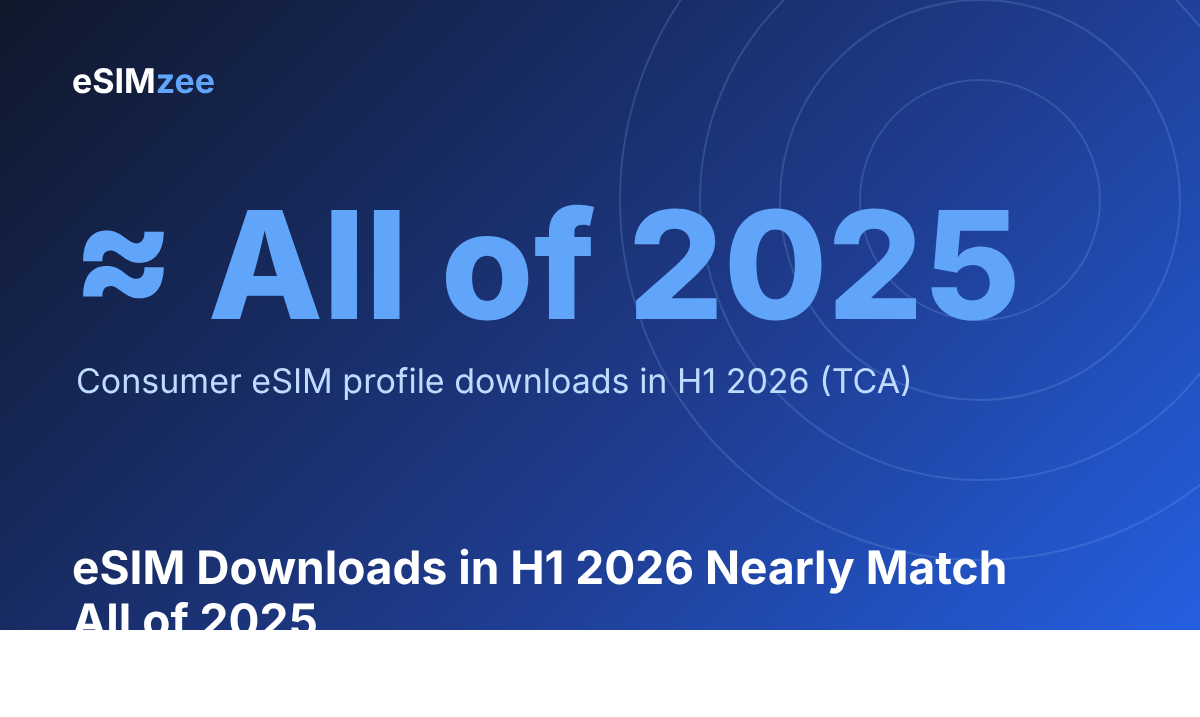
Consumer eSIM adoption is moving faster than at any point on record. According to the Trusted Connectivity Alliance (TCA), consumer eSIM profile downloads in the first half of 2026 alone nearly matched the volume for all of 2025.
That pace changes what travelers can expect from phones, carriers and travel plans. Here is what the data says and where it comes from.
Half a year nearly equals the whole of last year
The TCA is the industry association estimated to represent approximately 85% of the global eSIM hardware market. Its latest market monitoring insights, released on 1 October 2026, say consumer demand for eSIM technology accelerated sharply in the first six months of 2026.
In that period, worldwide consumer eSIM profile downloads equalled almost the same volume as the full year of 2025. A profile is the digital SIM file a phone downloads to connect to a network.
The year before was already strong. In its Trusted Connectivity Alliance full-year release of 2 March 2026, TCA reported that consumer eSIM profile downloads rose 43% in 2025.
China drives the surge
TCA credits a significant uplift in China for the global pace. Leading domestic operators received regulatory approval to offer eSIM services in October 2025. Major eSIM-enabled devices then launched in the region.
TCA also points to the availability of eSIM travel plans for inbound and outbound travellers. Adoption kept rising across North America and Europe, and in emerging markets such as the Middle East and Africa (MEA) and South America.
The earlier release shows where those emerging markets started. TCA said adoption effectively doubled across MEA and South America in 2025, while consumer uptake remained strongest in North America. It expects sustained growth in the emerging regions as network deployment continues through 2026.
The IoT side is scaling too
The same snapshot covers connected devices. Compared with full-year 2025, TCA data shows a fivefold increase in the number of eSIM Subscription Manager (SM) platforms that enable profile downloads under GSMA's eSIM IoT Specification, known as SGP.32.
SGP.32 simplifies remote provisioning and management of IoT devices. TCA reads the fivefold jump as a sign of infrastructure investment and rollout.
Physical SIMs are not going away
TCA members increased delivered SIM volumes by 6% year-on-year in the first half of 2026. The association describes the traditional SIM market as highly resilient amid digitalisation and rising eSIM demand.
The full-year 2025 release put the total available market for traditional SIM at 3.5 billion units. It also reported that TCA members' estimated eSIM shipments grew 18% to a record 605 million, with members themselves shipping 523 million eSIM units.
A warning on demand
TCA flags one risk. It says "well-publicised challenges facing near-term smartphone shipments" may create headwinds for eSIM demand in the year ahead.
That is TCA's assessment, not a measured decline. The H1 2026 figures show no slowdown in consumer downloads.
What this means for travelers
Support for eSIM is now the norm in new phones, and TCA's data shows travelers are acting on it. The practical result is a wider field of eSIM travel plans and more competition among providers.
- Check your phone first. TCA notes that low and mid-range smartphone models now include eSIM, alongside eSIM-only flagships in more markets outside North America.
- Expect more travel plans. TCA names eSIM travel plans for inbound and outbound travellers as one driver of China's growth.
- Keep your physical SIM. Traditional SIM volumes still grew, so a dual setup remains available.
Compare data allowances, coverage and prices side by side on the eSIMzee provider comparison page before you book your next trip.
Sources
- Trusted Connectivity Alliance Mid-Year Market Snapshot Reveals Acceleration in eSIM Adoption in 2026, Trusted Connectivity Alliance, 1 October 2026
- Trusted Connectivity Alliance Members Confirm Acceleration of Global eSIM Growth in 2025, With Estimated eSIM Shipments Increasing 18% and Consumer Adoption up 43%, Trusted Connectivity Alliance, 2 March 2026