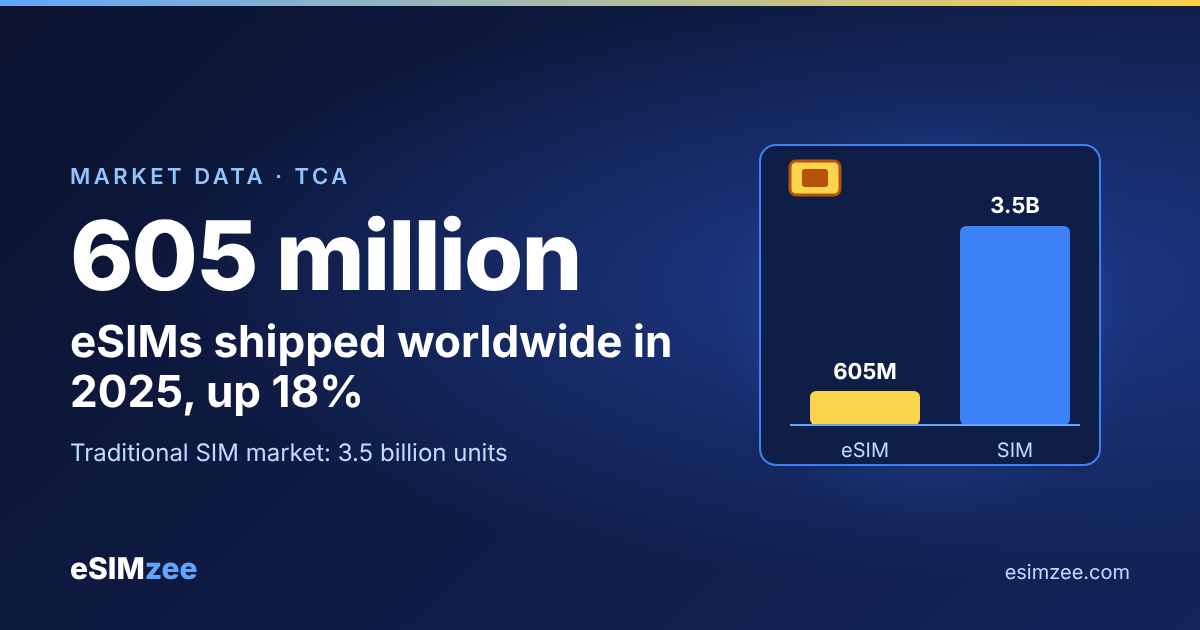
Global eSIM shipments reached 605 million units in 2025, up 18%, according to the Trusted Connectivity Alliance (TCA). The industry body's newest releases show the growth continuing in 2026, and they explain why more phones now support travel eSIMs.
eSIM shipments in 2025: the numbers
TCA estimates that it represents about 85% of the global eSIM hardware market. Its members estimate that the total number of eSIMs shipped worldwide grew by 18% in 2025, to a new annual high of 605 million. TCA members themselves shipped 523 million eSIM units.
Use followed shipments. Consumer eSIM profile downloads rose 43% in 2025. A profile download counts each time a phone installs a mobile operator's digital SIM file.
Adoption effectively doubled across the Middle East and Africa and across South America. Consumer uptake stayed strongest in North America.
Why more phones support eSIM
TCA ties the shipment growth to the rising number of eSIM-capable devices. That includes more low-end and mid-range smartphone models. It also includes flagship eSIM-only handsets launched in more markets outside North America.
For a buyer, this means the phone in your pocket is more likely to take a travel eSIM than a phone from two years ago. Check yours with the eSIMzee device checker before you buy a plan.
Physical SIMs are not going away
TCA estimates the market for traditional SIM cards at 3.5 billion units in 2025. TCA members raised delivered SIM volumes by 6% that year. In the first half of 2026, members again increased delivered SIM volumes by 6% year on year.
TCA chair Guido Abate says "eSIM adoption is accelerating across consumer and IoT use-cases" alongside the enduring strength of traditional SIM technology.
TCA members also reported 33% year-on-year growth in deployments of the Recommended 5G SIM, the SIM design built for the highest security and privacy on 5G and 5G standalone networks. Shipment volumes were highest in India, with North America second.
2026: downloads nearly match all of 2025
In the first half of 2026, consumer eSIM profile downloads worldwide nearly equalled the volume for all of 2025. TCA credits a significant uplift in China. Leading Chinese operators received regulatory approval to offer eSIM services in October 2025. Major eSIM-enabled devices followed, along with eSIM travel plans for inbound and outbound travellers.
TCA also flags a risk. It says well-publicised challenges facing near-term smartphone shipments may create headwinds for eSIM demand in the year ahead.
SGP.32 brings eSIM to IoT devices
SGP.32 is the GSMA's eSIM specification for Internet of Things (IoT) devices, such as trackers and meters. Compared with full-year 2025, TCA data shows a fivefold increase in eSIM Subscription Manager platforms that support profile downloads under the specification.
On 5 November 2026, TCA announced a webinar with the GSMA for 1 December. It will cover specification and certification updates and TCA's new technical paper on the SGP.32 ecosystem. TCA published that paper, IoT eSIM (SGP.32): A Technical Guide, on 15 October 2026.
What this means for travelers
More eSIM-capable phones and more consumer downloads mean a travel eSIM is a mainstream option for your next trip. Buy one before you fly if your phone supports it, and keep your home SIM active for calls and texts.
Compare current plans and prices from each seller on the eSIMzee providers page.
Sources
- Trusted Connectivity Alliance Members Confirm Acceleration of Global eSIM Growth in 2025, Trusted Connectivity Alliance, 2 March 2026
- Trusted Connectivity Alliance Mid-Year Market Snapshot Reveals Acceleration in eSIM Adoption in 2026, Trusted Connectivity Alliance, 1 October 2026
- IoT eSIM (SGP.32): A Technical Guide, Trusted Connectivity Alliance, 15 October 2026
- SGP.32: Promoting Interoperable and Consistent IoT eSIM Deployments, Trusted Connectivity Alliance, 5 November 2026