The GSMA has opened a €30,000 contest for AI agents in telecom: software that diagnoses and fixes problems in a mobile radio network. At the same time, AT&T says it is rebuilding its network so AI can run more of it by 2030. Both stories show where mobile networks are heading, and what travelers will notice first.
What is the GSMA AI Agents for RAN Challenge?
The GSMA announced two AI competitions on 10 November 2026 through its Open Telco AI initiative. The organisation works with ETSI, IEEE, ITU and Huawei, and the competition pages sit on Zindi.
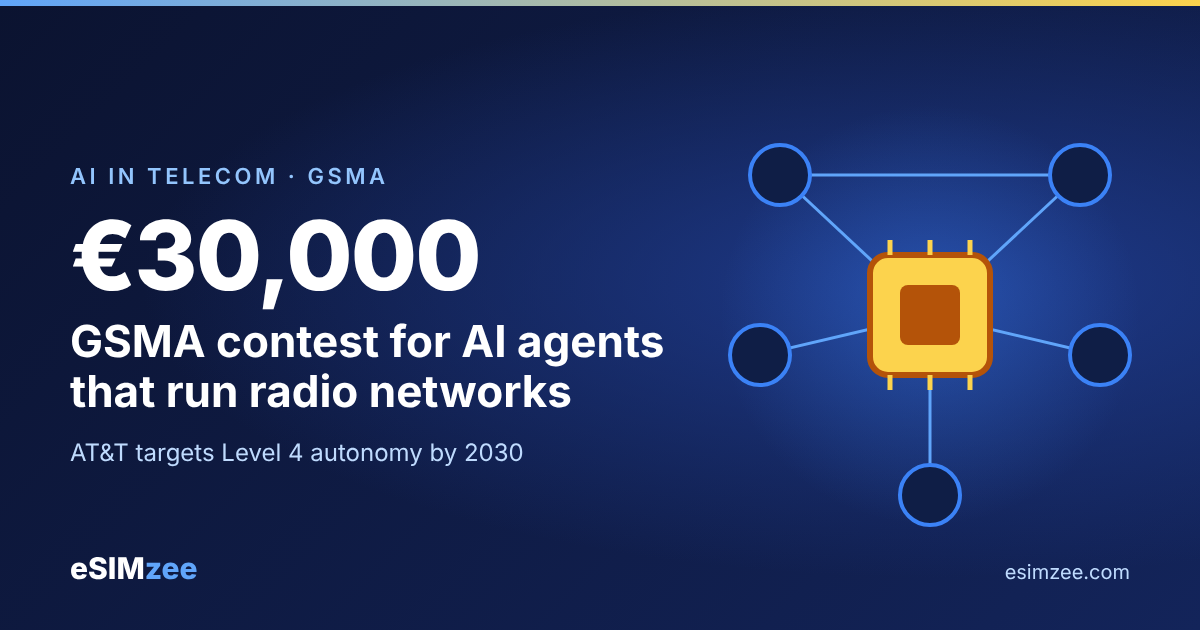
The AI Agents for RAN Challenge carries a €30,000 prize pool. RAN stands for radio access network, the cell towers and radio equipment that connect your phone to the operator.
Entrants build agents that reason, use tools and solve radio engineering tasks. The tasks include fault diagnosis, outage impact analysis, coverage and radio configuration, site placement and energy management. A webinar on 18 November 2026 explains the challenge and its open-source simulator, Giulia, built by Universitat Politècnica de València.
How are the entries judged?
The GSMA scores entries on accuracy, efficiency, reasoning and security. Agents must investigate network conditions, test possible fixes and assess how each change affects the wider network.
Winners are recognised at an awards ceremony at MWC27 Barcelona.
The contest matters because radio networks are complex and expensive to run. An agent that spots a fault, tests a fix and checks the side effects is the automation the GSMA wants. Its stated goals are better reliability, lower costs and a better customer experience.
The second challenge: AI that reads telecom standards
The TelcoRetrieve Challenge targets a different problem. It asks teams to build an open, vendor-neutral retrieval-augmented generation (RAG) pipeline, which lets an AI answer questions by looking up source documents and linking its answer to them.
The documents come from bodies such as 3GPP, ETSI, GSMA, ITU and TM Forum. Its prize pool is €25,000, with compute provided by AMD, and a webinar runs on 13 November 2026.
Why AT&T is betting on autonomous networks
Fierce Network reported on 9 November 2026 that AT&T has set an internal goal of Level 4 network autonomy by 2030. Network CTO Yigal Elbaz spoke at FutureNet North America in New York.
AT&T is moving toward open, disaggregated, programmable designs across its RAN, standalone 5G core, and IP and optical networks. It already uses AI for cell-site energy savings and for wireless network planning, and it built its own network foundation model.
Elbaz named three barriers: data integrity, resolving conflicts when several AI agents reach different conclusions, and trust in AI outcomes. That last point connects directly to the GSMA contest, which scores security and reasoning.
The same article reports that AT&T and AST SpaceMobile completed a handoff between AT&T's cellular network and AST's direct-to-device satellite network. The companies call it an industry first. The article gives no launch date and announces no new customer product or price.
What this means for travelers
You will not see an AI agent on your phone screen. The GSMA names reliability and customer experience as the goals.
Neither story changes the price of an eSIM today. Both point at the same goal: fewer outages, faster fixes and smoother handoffs between networks. Elbaz described the aim as customers staying "always seamlessly connected to the best available network".
For now, choose your travel eSIM by the plan terms you can verify: data amount, validity, price and whether it supports hotspot or calls. Compare current plans from every provider on the eSIMzee providers page. Treat AI-run networks as a future benefit, not a reason to buy today.
Sources
- New AI Challenges Launch to Advance Network Automation and Standards Knowledge, GSMA, 10 November 2026
- AT&T is rebuilding its network for the AI and autonomous era, Fierce Network, 9 November 2026